
The Business That Can't Run Without You
Founder dependency is the degree to which your business relies on you, personally, to keep functioning.
There is a particular kind of exhaustion that comes from being pulled in twenty directions at once, making decision after decision as though the fate of your business rests on each one.
You start the day already behind, because your inbox and Slack have filled overnight with things that need your approval.
You built this business to give you freedom, and it has quietly become the thing you are least free from.
If you have ever thought, even briefly, this only works because I'm holding it together, this is for you.
Because that thought is not a sign that you are failing. It's a sign that the structure needs to be addressed. And structures can be redesigned.
What founder dependency actually is
Founder dependency is the degree to which your business relies on you, personally, to keep functioning. Not your vision. Not your leadership. You. Your hands, your memory, your judgement applied to the same decisions over and over.
It rarely announces itself. It accumulates. While you were building the business, it was important for you to be at the centre of everything. You were close to the strategy, iterating as you went. Delivery ran through you, which is how the quality held. You carried the relationships. That closeness is what brought the business to where it is today, and it is part of why it worked as well as it did.
But you are no longer building this business. You are scaling it. And the way a scaling business needs to be structured is very different from the way it was built.
The same closeness that builds a business can become the thing that caps it. What served you at one stage starts to constrain you at the next. The business grows, but it grows around you rather than beyond you. Revenue climbs and the weight climbs with it.
This is why so many capable founders hit a ceiling that has nothing to do with capability. You are not short on skill or commitment. You are carrying a structure that was never redesigned for the size it has reached.
Why working harder doesn't solve it
The instinct, when the business depends on you, is to become more efficient inside the dependency. Wake earlier. Systematise your own time. Find a better way to do everything you're already doing.
It feels productive. It rarely changes anything, because it treats a structural problem as a personal one.
If the only way the business holds together is through your continuous effort, then more effort doesn't release you. It deepens the dependency. You become more efficient at being indispensable, which is the opposite of what you actually want.
The work isn't to carry the load better. It's to change what the load is resting on.
The seven ways a business comes to depend on you
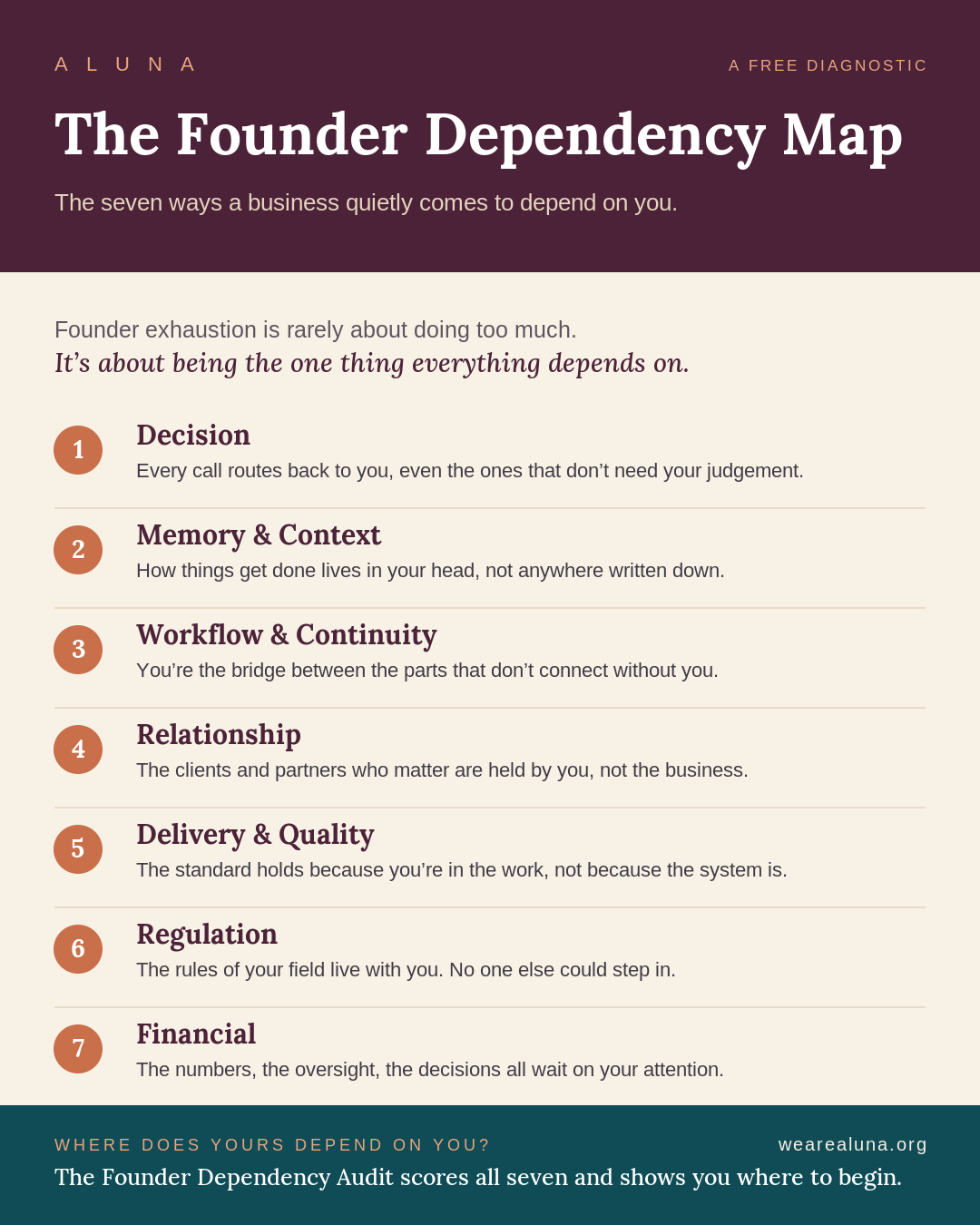
Founder dependency is rarely one big thing. And it isn't really about where in the business you sit. It's about what kind of hold the business has on you. Once you look at it that way, the same heaviness separates into distinct threads, each one a different way the business has quietly been built to need you.
There is decision dependency, where choices route to you by default, not because they need your judgement but because no one else is structured to make them. There is memory dependency, where the knowledge of how things are done lives in your head rather than in anything documented. There is workflow dependency, where you are the bridge between parts of the business that don't yet connect to each other directly. There is relationship dependency, where the clients and partners who matter are held by you personally, not by the team.
Then there is delivery dependency, where the quality clients pay for is quality that only your presence guarantees. There is regulation dependency, where the compliance and the rules of your field are understood by you and no one else. And there is financial dependency, where the money decisions, the oversight, the visibility into how the business is really doing all wait on your attention.
Each of these is a different mechanism. Each one can be released in a different way. And almost no founder is dependent across all seven evenly. The work is to see which threads are pulling hardest in your business specifically, because that is where redesign begins.
That's the shift Aluna is built on. The goal is not for you to disappear from your business. It's for the business to be designed so that your presence is a choice, not a requirement. So that when you step back, things hold. So that scale doesn't mean more weight, it means more structure carrying it.
This is what regenerative business design means in practice. A business that restores your capacity instead of drawing it down. One that gives back more than it asks of you.
Naming it is where it starts
You can't redesign what you can't yet see clearly. Most founders sense the dependency long before they can locate it. They feel the tiredness without being able to point to its source.
So the first move is not a strategy. It's an honest audit. A way of mapping which of those threads is leaning on you hardest, and what would actually release each one. Once it's named, it stops being a vague heaviness and becomes something specific. And specific things can be changed.
That clarity is the difference between I need to work less and I can see the three places my business is built to need me, and here is where I'd begin.
One of those is a wish. The other is the start of a redesign.
Find out where your business depends on you
The Founder Dependency Audit is a simple, structured worksheet that walks you through the seven types of dependency and shows you, plainly, which ones your business is built on.
It takes around ten to fifteen minutes. You rate fourteen short statements, and the worksheet builds you a dependency profile in return. It shows you which kind of dependency is highest right now, what would most likely happen if you stepped back today, and the single structural change that would release the most weight first. It gives you a clear view of the structure you've been carrying, so you can see what's actually holding the weight.